What Is a Sovereign Cloud? Why Is It Important for Your Business?
Your data may be in India, but whose laws control it? A sovereign cloud keeps your data, operations and encryption keys under the laws of your own country. In this guide, learn what a sovereign cloud is, how it compares to the regular public cloud, which industries need it, and what to check before you choose one.
Varun Patel
CEO
A government tender asks one question you can't answer: "Where is citizen data stored, and who can access it?" A hospital client wants proof that patient records never leave India. An EU customer's legal team sends a 40-question data questionnaire. Suddenly, "we're on the cloud" is not a good enough answer.
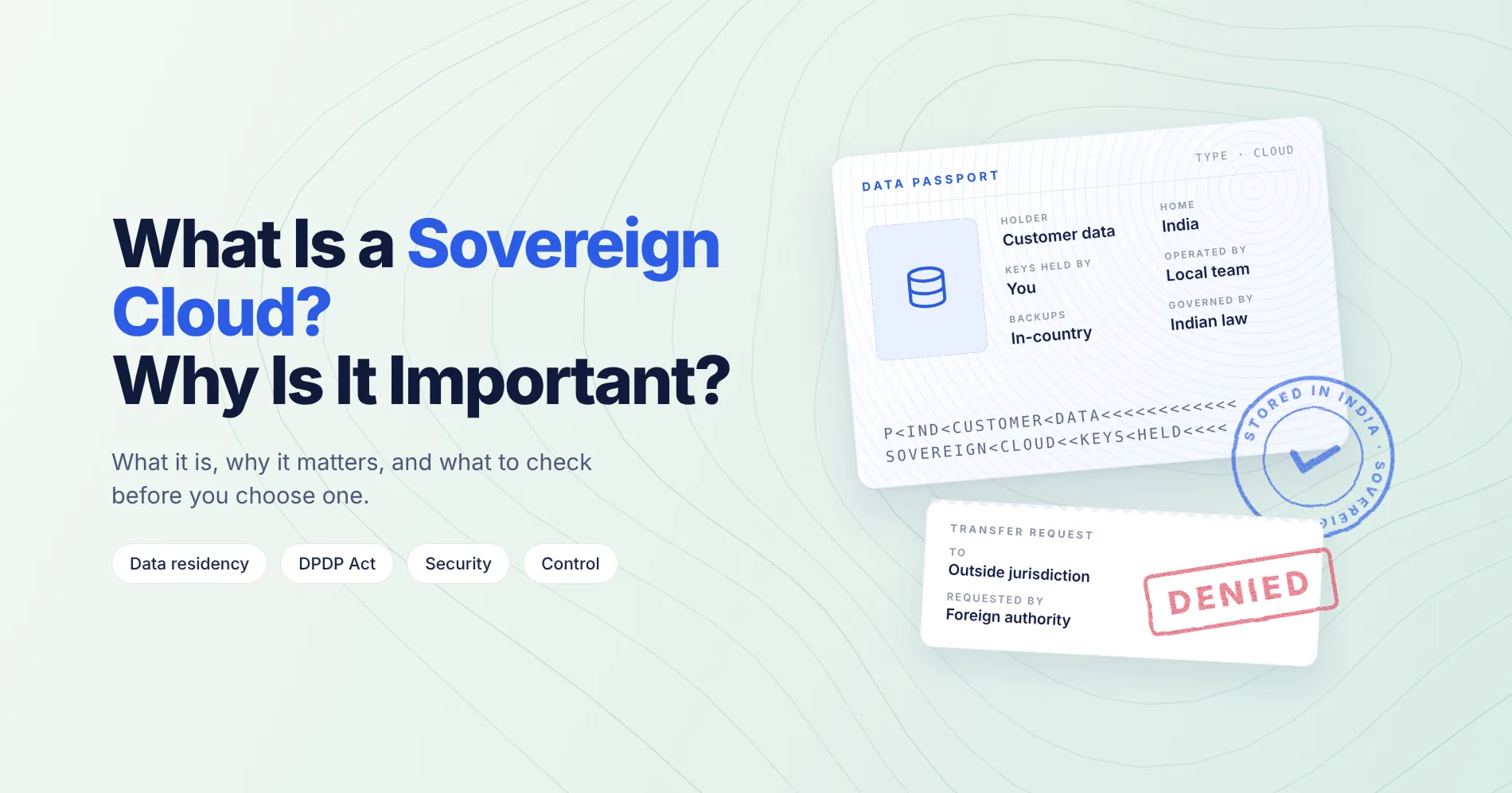
A sovereign cloud solves this. It keeps your data, the people who operate it and the keys that unlock it under the laws of one country. This guide explains what a sovereign cloud is and how it works. It also covers why it matters now, which industries need it most and how to choose the right one.
At Skyphr, we design and build custom software, SaaS products and AI systems for clients across sectors. Where data lives, and who can reach it, is part of every architecture decision we make. Everything here comes from real project work, not theory.
What is a sovereign cloud?
A sovereign cloud is a cloud environment where your data, its operations and its security controls stay under the legal jurisdiction of a specific country or region.
It usually rests on three pillars:
Data sovereignty. Data is stored and processed inside the country, including backups and disaster recovery copies.
Operational sovereignty. The infrastructure is run and supported by vetted local staff, under local law.
Technical sovereignty. You control the encryption keys and access logs, and you can move your workloads out if you need to.
The key point: a sovereign cloud is not just about where the server sits. A data centre in Mumbai run by a company that must answer to a foreign government is "local", but not fully sovereign. Laws like the US CLOUD
Act let authorities request data from US providers even when it is stored abroad. Sovereignty is about whose rules apply, not just whose soil.
You'll also hear related terms like data residency, data localisation, in-country cloud or government community cloud. Data residency answers "where is my data?" Sovereignty answers "who controls it?"
Sovereign cloud vs public cloud: what's the difference?
| Aspect | Standard public cloud | Sovereign cloud |
|---|---|---|
| Data location | Any region, often global | Inside one country or region |
| Legal control | Provider's home country laws can apply | Local laws only |
| Who operates it | Global support teams | Vetted local staff |
| Encryption keys | Often held by the provider | Held by you or in-country |
| Best for | General apps, global reach | Regulated, sensitive or public-sector data |
How does a sovereign cloud work? A typical data journey
A customer submits data through your app, such as a health record, payment detail or ID document.
The data is stored only in data centres inside the country, including backups.
It is encrypted with keys that you hold, not the cloud provider.
Only approved, locally based staff can access the systems that run it.
Every access is logged, and you can audit those logs at any time.
If the provider receives a foreign data request, the legal and technical setup means it cannot simply hand your data over.
Why sovereign cloud is important now
Sovereign cloud has moved from a niche government topic to a mainstream business decision. A few reasons:
India's data protection law is now live. The DPDP Rules were notified on 13 November 2025, and penalties under the DPDP Act go up to ₹250 crore. Cross-border transfer rules are expected to take effect on 13 May 2027, and the government can restrict transfers to specific countries.
Sector rules already require local data. RBI rules require payment system data to be stored in India. Government workloads must run on MeitY-empanelled cloud providers.
Global buyers ask harder questions. If you sell software to Europe, GDPR and EU sovereignty frameworks shape what your customers will accept.
The big providers are responding. In January 2026, AWS launched its European Sovereign Cloud, a separate cloud run from within the EU. Indian providers are launching sovereign offerings too.
The market is growing fast. Gartner forecasts worldwide sovereign cloud IaaS spending of $80 billion in 2026, up 35.6% from 2025.
AI raises the stakes. Prompts, training data, and AI logs often contain customer and business data. Where that data is processed matters as much as where it is stored.
6 benefits of a sovereign cloud for your business
Easier regulatory compliance. Meeting data localisation and data protection rules is simpler when the platform is built for them.
Lower legal risk. Your data stays out of reach of foreign laws and cross-border data requests.
Access to regulated contracts. Government, banking, and healthcare deals often require in-country hosting to even qualify.
More customer trust. "Your data never leaves India" is a strong, simple promise in sales conversations.
Full control over your data. You hold the keys, see the access logs, and decide who gets in.
Less vendor lock-in. Good sovereign setups use open standards and clear exit plans, so you can move if you need to.
The hidden cost of ignoring data sovereignty
Try this simple calculation for your business:
Value of deals that require local hosting × share you can't bid on today = revenue locked out each year
Then add the risk side: the cost of a forced migration if a client or regulator demands it later. Moving a live product to a new cloud under deadline pressure is slow and expensive. Planning for sovereignty early is far cheaper than retrofitting it once a big contract is on the table.
Best sovereign cloud use cases by industry
Government and public sector: citizen services, records and e-governance platforms.
Banking, fintech and insurance: payment data, KYC records and transaction systems.
Healthcare: patient records, diagnostics, telemedicine and hospital management systems.
Defence and aerospace: sensitive engineering, supply-chain and operational data.
Education and edtech: student records and exam data, especially for government programmes.
Legal and consulting firms: client files and confidential case documents.
SaaS companies: selling into regulated industries or regions with strict data rules.
AI products: training data, model hosting and inference logs that contain personal data.
How to choose the right sovereign cloud
Before you invest, ask these questions:
Where exactly is the data stored? Check primary storage, backups and disaster recovery sites. All of them should be in-country.
Which laws does the provider fall under? A local data centre owned by a foreign company may still face foreign legal requests.
Who holds the encryption keys? Ideally you do, through your own key management.
Who can access the systems? Ask where support staff are based and how access is approved and logged.
Is it certified? Look for MeitY empanelment for government work, plus ISO 27001 and SOC 2.
Does it have the services you need? Check for managed databases, Kubernetes, GPUs and AI services, not just basic servers.
Can you leave? Ask about data export, open standards and a clear exit plan.
Not every workload needs a sovereign cloud. Many businesses use a hybrid setup: sensitive data on a sovereign cloud, public-facing and non-sensitive parts on a global cloud. Getting that split right is an architecture decision. It pays to plan it with a team that does both custom software development and cloud-ready SaaS product development
How Skyphr builds on sovereign cloud
We don't push one cloud for every client. We design your system around your data, your regulations and your customers:
Discovery: we map what data you collect, where it flows, and which rules apply, such as DPDP, RBI or MeitY guidelines.
Design: we decide which workloads must stay sovereign and which can run on a global cloud, then plan keys, access and backups.
Build and migration: we build new systems or move existing ones to the right provider with minimal downtime.
Testing: we test security, access controls, failover, and data export before go-live.
Launch and improve: we monitor performance, cost, and compliance, and adjust as rules change.
Building AI into a regulated product? Our custom AI agents and integrations team designs AI workflows that keep sensitive data where it belongs. Explore SkyAI to see what we build.
Frequently asked questions
Ready to take control of your data?
Your customers and regulators increasingly want to know where their data lives and who can reach it. A sovereign cloud, planned well, gives you a clear and confident answer.
Book a free 30-minute consultation with Skyphr to review your cloud setup, or explore SkyAI to see what else we build with AI. While you're here, get a free website audit with SkyLens to check your site's security, speed, and SEO.