The True Cost of Technical Debt at Enterprise Scale
Technical debt rarely shows up as a bug. It shows up as friction: longer estimates, nervous deployments, and code nobody wants to touch. Here's why it compounds quietly, why a full rewrite is usually the wrong instinct, and how a short architecture review up front can save months of rework.
Varun Patel
Founder
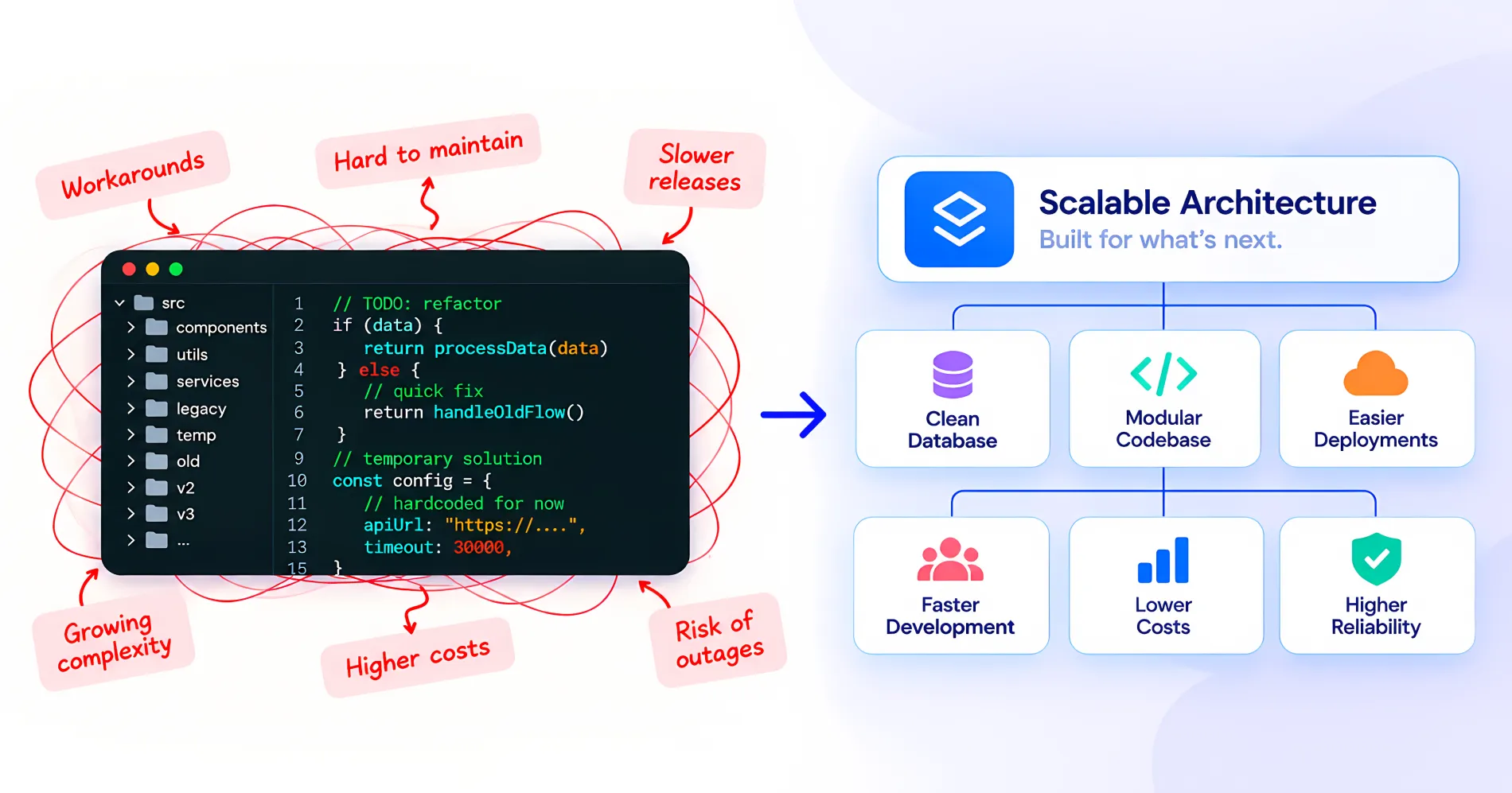
Most founders find out about technical debt the same way. A feature that used to take a week now takes a month, and nobody can say exactly why.
Nothing dramatic happened. No outage, no resignation, no bad hire. The team is the same. The effort is the same. But every estimate has gotten longer, and every "quick fix" now touches four other things first.
That's technical debt showing up. Not as a bug. But as friction.
It's not a coding problem. It's a pressure problem.
We have built software long enough to know that almost no technical debt comes from engineers being careless. It comes from decisions that were completely reasonable at the time:
“Ship it now”, “Clean it up” later. Pick the schema that's fastest today. Build the login flow that gets the product out the door.
Every one of those calls made sense for the company that existed then - a smaller team, a smaller user base, a launch deadline that mattered more than the next three years. The problem isn't that the decision was wrong. It's that "later" almost never actually arrives, because there's always a more urgent thing to ship first.
Debt compounds in two ways, and both are quiet
The first is that shortcuts stop looking like shortcuts. A workaround that was supposed to last a month becomes permanent, because ripping it out now means touching everything built on top of it since. What started as a small compromise turns into load-bearing infrastructure nobody wants to touch.
The second is that growth changes the rules. Whatever you built was sized for the company you were then, not the one you've become. The approach that let you move fast with a small user base can become the exact thing slowing you down once you're operating at real scale. And by the time that shows up, it's already expensive to unwind, because every feature since has been built on top of it.
This is not a system failure. It's a sentence.
You don't need a dashboard to catch this. You'll hear it in the room. Simple requests start getting hedged: "it depends on what we'd have to touch." Deployments start making people nervous instead of routine. Certain parts of the codebase quietly become the parts nobody wants to be the one to change.
That sentence - it depends on what we have to touch - is the moment a technical question becomes a business one. It's no longer about code quality. It's about velocity, cost, and how confidently you can promise a delivery date to your customers.
The instinct to rewrite is usually the wrong instinct
The natural reaction, once the pain is visible, is "let's start over." New stack, clean architecture, do it right this time.
Sometimes that's genuinely the right call. More often, it just relocates the problem. A rewrite takes longer than planned; the roadmap stalls while it's underway, customers keep waiting on improvements that aren't coming, and once the new system ships, the same pressures that created the first round of debt are still there, quietly building the second round.
The uncomfortable truth is that the code was never really the problem. The process that produced the code was. If that process doesn't change, a rewrite is just a more expensive way of arriving back where you started.
What actually holds up over time is less dramatic: fix the structural problems that are genuinely costing you speed, while continuing to ship. It's slower to talk about and much less satisfying than "we rebuilt everything" - but it's the version that doesn't blow up your roadmap for two quarters.
What's worth watching for
Sprint velocity and deployment frequency are useful, but they won't tell you this is happening until it's already expensive. A few better signals:
Are simple features taking longer to ship than they did six months ago? Are engineers visibly more cautious before a release than they used to be? Are incidents increasingly traced back to the same handful of components? Do the same problem areas keep coming up in retros, unaddressed?
Your engineers already know where the weak points are. Most teams just haven't built a habit of asking.
The cheapest fix is the one you make before you build
A short architecture review before a new system, or a major feature, gets built can save months later. It doesn't need to be a weeks-long process. A focused conversation answering a handful of questions is usually enough: What does this need to support at meaningfully more scale than today? Which choices here get expensive to reverse a year or two out? Are we picking the familiar option or the correct one? Is testing actually part of the plan, or an afterthought? Is this ready to run in production, not just on someone's laptop?
None of these questions are exotic. They just rarely get asked early enough.
Why this matters more at enterprise scale
For a small team, technical debt is annoying. For an enterprise, it's operational risk. There are SLAs, integrations, security and compliance obligations, and customer commitments sitting on top of the same foundation. A weak layer underneath doesn't just slow developers down; it raises the odds of outages, security gaps, and compliance exposure, all of which cost more to fix after the fact than before.
That's the real shift: technical debt stops being something engineering quietly manages, and becomes something the business has to actively decide how to handle.
This is exactly what we do at Skyphr , treating architecture as a decision the business should take from the start, not a cleanup job that will be done later.
You can't eliminate technical debt. Every system accumulates some, and that's not automatically a failure. But you can make sure it's a decision you made on purpose, not one that made itself while nobody was watching.
So - what's the oldest shortcut still sitting in your stack, and does anyone still remember why it's there?