Questions to Ask When Implementing AI. A Practical Checklist for Leader
Most AI projects fail before a single line of code is written. The wrong problem, messy data or unclear ownership can turn a promising idea into wasted budget. In this guide, learn the key questions to ask when implementing AI, how planned AI adoption compares to ad hoc experiments, what to ask your AI vendor, and how to set up your first project for success.
Varun Patel
CEO
You've seen the demos. A competitor says they've "added AI". Your team is excited, and a vendor has already sent a proposal. Then, three months and a big invoice later, the tool sits unused because nobody asked the right questions at the start.
Asking the right questions when implementing AI solves this. A clear set of questions turns a vague "we should use AI" into a focused project with a goal, a budget, and an owner. This guide explains what AI implementation really involves and the questions to ask at each stage. It also covers what to ask your AI vendor and how to pick a first project that actually pays back.
At Skyphr, we build custom AI systems through SkyAI, our AI engineering division. We also run our own AI products, like Sky, our AI voice agent, and SkyLens, our website audit tool. Every question here is one we ask in real client discovery calls. Everything here comes from real deployment, not theory.
What does implementing AI actually involve?
Implementing AI means putting an AI system into a real business workflow so it does useful work every day, not just in a demo.
Every AI implementation has three parts:
The model. The AI itself, such as a large language model (LLM), a vision model, or a prediction model.
Your data. The documents, records, and history that make the AI specific to your business.
The workflow. The connections to your CRM, ERP, helpdesk, website or app that let the AI take action.
Most teams spend their time choosing the model. In practice, data and workflow decide whether the project succeeds. A great model with no access to your systems is just a clever chatbot.
You'll also hear this called AI adoption, AI integration, or AI transformation. The idea is the same: making AI part of how your business runs.
Ad hoc AI experiments vs planned AI implementation: what's the difference?
| Aspect | Ad hoc AI experiments | Planned AI implementation |
|---|---|---|
| Starting point | A tool someone liked | A business problem with a cost |
| Data | Copied and pasted manually | Connected, cleaned and controlled |
| Success measure | "It looks impressive" | One clear, tracked metric |
| Risk and security | Usually ignored | Planned from day one |
| Result after 6 months | Abandoned or unmanaged | Used daily and improving |
How does an AI implementation work? A typical project
You pick one business problem that costs real time or money.
You check whether the data needed to solve it exists and can be accessed.
A small pilot is built for that one workflow, with guardrails and human review.
Real users test it, and results are measured against the goal you set.
If it works, the system is connected more deeply to your tools and rolled out.
Usage, cost and quality are monitored, and the system improves over time.
The questions below map to these stages. Answer them in order, and most of the common mistakes disappear.
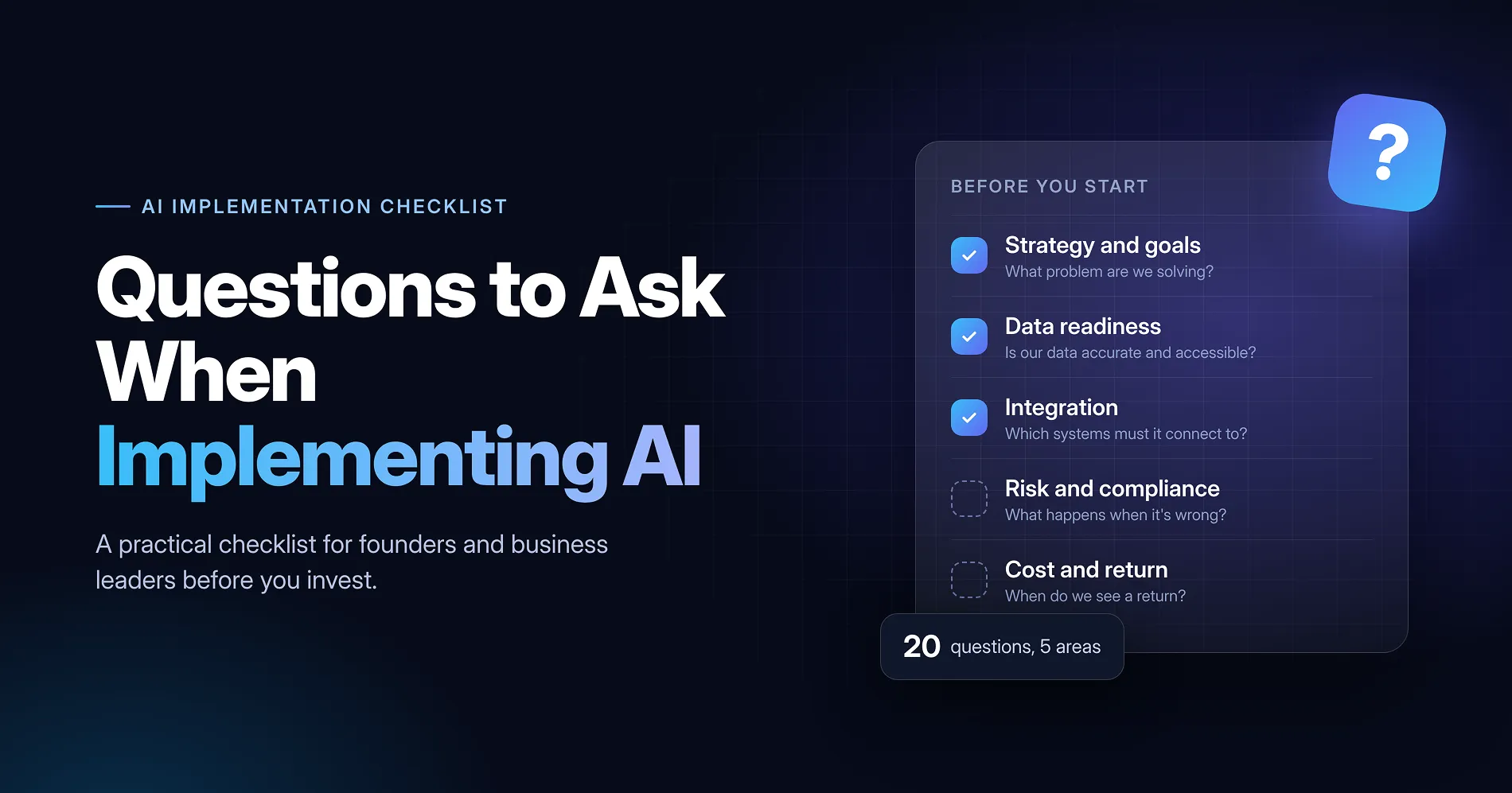
20 questions to ask when implementing AI
Strategy and goals
What exact problem are we solving? "Use AI in support" is not a problem. "Reply to routine support enquiries within five minutes" is.
How will we measure success? Pick one primary metric, such as hours saved, response time, leads converted or errors reduced.
Does this problem actually need AI? Some tasks are solved faster and cheaper with simple automation, a better form or a cleaner process.
Who owns this project on the business side? AI projects without a clear business owner drift. The owner decides priorities and signs off on results.
Data readiness
What data does the AI need, and where does it live today? List the sources: documents, spreadsheets, CRM records, emails or call transcripts.
Is that data accurate and up to date? AI repeats whatever it is given. Outdated policies and duplicate records lead to confident wrong answers.
Who owns and can access this data? Check permissions early. Some data may belong to clients or partners and come with contract limits.
Will our data be used to train someone else's model? Read the provider's terms. For business data, the answer should be no.
Technology and integration
Which systems does the AI need to connect to? An AI that can't read your CRM or update your helpdesk creates extra copy-paste work.
Should we build custom, buy off-the-shelf or combine both? Ready-made tools suit general tasks. Core, customer-facing workflows usually need a custom fit.
Which AI model fits this task, and can we switch later? Models improve fast. A good setup lets you change models without rebuilding everything.
Can this pilot scale into a full system? Build the pilot on a foundation that can grow, so success doesn't mean starting over.
Risk, security and compliance
What happens when the AI is wrong? Plan for mistakes. Decide which outputs need human approval and how errors get caught and fixed.
Which regulations apply to our data? In India, the DPDP Act governs personal data. Sector rules, such as RBI guidelines for payments, may add more. Global customers may bring GDPR into scope.
How do we keep sensitive data safe? Look at encryption, role-based access, audit logs and where data is processed and stored.
What are the AI's limits and rules? Define what it may say, what it must never do and when it should hand over to a person.
People, cost and return
How will this change our team's daily work? Explain the change early. Teams adopt AI faster when they see it removes their most boring tasks.
Who will maintain and improve the system after launch? AI is not "set and forget". Someone needs to review outputs, update data and tune prompts.
What is the full cost, not just the build? Include model usage fees, hosting, integration, monitoring and ongoing improvement. Usage-based costs grow with volume.
When do we expect to see a return? Set a realistic review point, such as 60 or 90 days after launch, and decide in advance what "worth continuing" looks like.
The hidden cost of skipping these questions
Try this simple calculation for your business:
Months spent on the wrong AI project × monthly project cost + team hours lost to rework × hourly cost = cost of a poorly planned AI project
That number doesn't include the harder loss: a team that tried AI once, saw it fail, and now resists the next attempt. A few hours spent on these questions upfront is the cheapest insurance an AI project can have.
Best first AI projects by business function
If you're unsure where to start, these workflows usually answer the questions above well:
Customer support: answering routine enquiries and drafting replies for agents to approve.
Sales: qualifying leads, summarising calls and drafting follow-up emails.
Front desk and phone lines: an AI voice agent that answers calls and books appointments 24/7.
Operations: extracting data from invoices, forms and reports.
HR: answering policy questions and screening CVs against clear criteria.
Marketing: first drafts of product descriptions, blogs and social posts in your brand voice.
Internal knowledge: an assistant that answers staff questions from your own documents.
Questions to ask your AI vendor or development partner
Before you sign, ask these questions:
Have you built something similar before? Ask for a live demo or a case study, not just slides.
How will you test accuracy before launch? A good partner tests with your real examples and shares the results.
Who owns the code, prompts and data? You should own what you pay for, including transcripts and outputs.
How do you handle security and compliance? Ask where data is stored, who can access it and how it is logged.
What does support look like after go-live? Clarify monitoring, fixes, updates and response times.
Can we start small? A partner who pushes a large build before a pilot is a warning sign.
AI rarely works alone. It sits on top of your website, CRM, internal tools or mobile app, and those often need work too. That's why it pays to plan everything with a team that does both custom AI agents and integrations and custom software development
How Skyphr implements AI for your business
We don't sell a one-size-fits-all AI tool. We work through these questions with you, then design, build and deploy AI around how your business actually works:
Discovery: we find the workflow with the clearest return, check your data and agree on one success metric.
Design: we plan the data flow, guardrails, user experience and where people stay in control.
Build and integration: we connect the right model to your data and systems, such as your CRM, ERP or helpdesk.
Testing: we test real scenarios for accuracy, security and edge cases before anyone relies on it.
Launch and improve: we monitor usage, cost and quality, and refine the system over time.
We start with a focused pilot and build it to scale. Building a product with AI at its core? Our SaaS product development team can take it from MVP to a full platform.
Want to see AI implementation in practice? Explore SkyAI, or book a call to hear Sky, our AI voice agent, in a live demo.
Frequently asked questions
Ready to implement AI the right way?
Most AI projects don't fail because of the technology. They fail because the right questions weren't asked at the start. Answer them first, and your first AI project has a real chance to pay back.
Book a free 30-minute consultation with Skyphr to walk through these questions for your business, or explore SkyAI to see what we build with AI. While you're here, get a free website audit with SkyLens to check that your site is ready for AI-driven search and customers.