From Reacting to Predicting. The Shift Every Brand Needs to Make
Most businesses make decisions based on what already happened. The ones pulling ahead use the data already in their ERP, CRM, and sales sheets to see what's coming, like demand spikes, customer churn, and slow months. Here's what that shift looks like and how to start with just one prediction.
Varun Patel
Founder
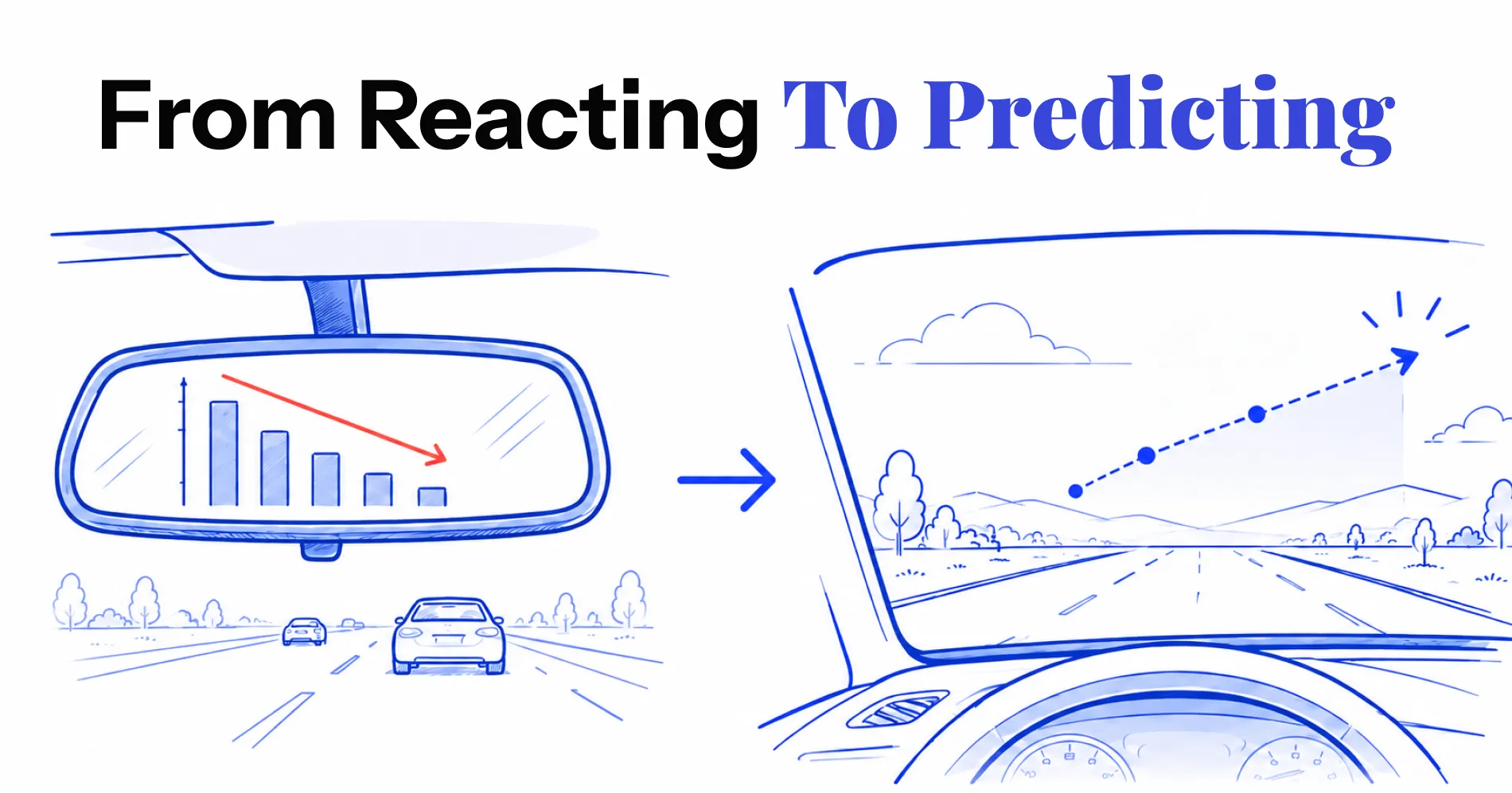
Your reports tell you what happened. The brands pulling ahead want to know what's about to happen.
Most businesses we speak with are driving while looking in the rearview mirror.
They're not careless. They work hard, they track their numbers, and they review reports every month. But almost every decision they make is based on something that has already happened.
Sales dropped last month, so now we plan a discount.
Stock ran out, so now we reorder.
A good client stopped replying, so now we call them.
Each of these moves makes sense. But each one comes after the damage is done.
we've come to believe this is one of the highest hidden costs in business today. It isn't a lack of effort or a lack of data. It's the habit of reacting.
The Reactive Loop Most Businesses Are Stuck In
Almost every business runs on the same quiet loop:
Something happens → we notice → we react.
The problem is the gap between "something happens" and "we notice." For most companies, that gap is weeks long. It's the time between a slow week and the month-end report, between a customer losing interest and that customer leaving, and between rising demand and an empty shelf.
In that gap, money is lost quietly.
Picture a distributor preparing for Diwali. Based on last year's numbers, they stock up on what sold well. But buying patterns have shifted this year. One product line is suddenly in high demand, and another has slowed down. By the time the sales report shows it, the festive window has passed. They're left with excess stock of one item and missed sales on another.
Nobody made a bad decision. They just made it too late.
You Already Have the Data. You're Reading It Backward.
The surprising thing is that most businesses already have what they need to see these problems coming.
Their ERP knows what's selling and how fast. Their CRM knows which customers are buying less often. Their sales sheets hold years of seasonal patterns.
But all of this data is used for one purpose: explaining the past. We look at it to answer "What happened?" and "Why did it happen?"
We almost never ask it the more valuable question: "What's about to happen?"
This isn't because business owners don't want to know. It's because finding patterns across thousands of rows, dozens of products, and hundreds of customers is simply too much for a person to do every week. So the data sits there, answering yesterday's questions.
What Predicting Actually Looks Like
This is where AI changes things. It isn't a futuristic idea anymore. It's a practical tool that works quietly in the background.
When AI is connected to the data a business already has, it can spot patterns people would miss and flag them early. In practice, that looks like this:
Demand forecasting. Instead of stocking based on last year, the business sees which products are likely to run out in the coming weeks and why.
Customer churn signals. Instead of noticing a client has left, the team gets an alert that a customer's buying pattern has changed, while there's still time to reach out.
Stock and cash planning. Instead of being surprised by a slow month, the business sees it coming and plans purchases and cash flow around it.
Instant answers. Instead of waiting for someone to prepare a report, the owner simply asks, "Which products are slowing down this month?" and gets an answer in seconds.
None of this requires replacing existing systems. The best predictive setups work with the ERP, CRM, and tools a business already uses.
Why This Shift Matters Now
For a long time, predictive systems were something only large companies could afford, with dedicated data teams and expensive software.
That has changed. AI has made it possible for small and mid-sized businesses to get the same kind of foresight without building a data department.
This creates a new gap in the market. Every industry now has two kinds of businesses:
The ones that react and are always catching up.
The ones that predict and are always a step ahead.
The second group isn't smarter or luckier. They've simply started reading their data forward instead of backward.
Where to Start
The biggest mistake I see is trying to "do AI" everywhere at once. That usually leads to expensive projects that never deliver.
The better approach is to start small:
Pick one decision that hurts when you get it wrong. For some businesses, that's stock. For others, it's losing customers, or cash flow.
Look at the data you already have for that decision. Usually, it's enough to start.
Build one prediction around it, and measure the difference. Once that works, move to the next.
One good prediction that saves real money is worth more than ten AI features nobody uses.
Closing Thought
Reacting keeps a business running. Predicting keeps it ahead.
The data to make this shift is probably already sitting inside your systems. The only question is whether you'll keep using it to explain the past, or start using it to see what's coming.
At Skyphr we help businesses make this shift one step at a time. We start with the single prediction that matters most, whether that's demand, stock, or customer churn, and we build it on top of the systems you already use.
If you're curious what your own data could predict, send me a DM. I'm happy to walk you through where to start.
If this was useful, subscribe to Skyphr Insights for practical ideas on AI, software, and business growth, written for business owners rather than engineers.