6 Success Stories Where Application Modernization Helped Reduce Tech Debt
Tech debt slows every release and quietly drains your budget. These 6 real application modernization success stories, from Amazon, GitHub, Shopify, Netflix, Segment and Prime Video, show how teams cut that debt and what it saved them. Learn what each team changed, the patterns behind every win, and how to plan modernization for your own product.
Bhavini Patel
Business Development Executive
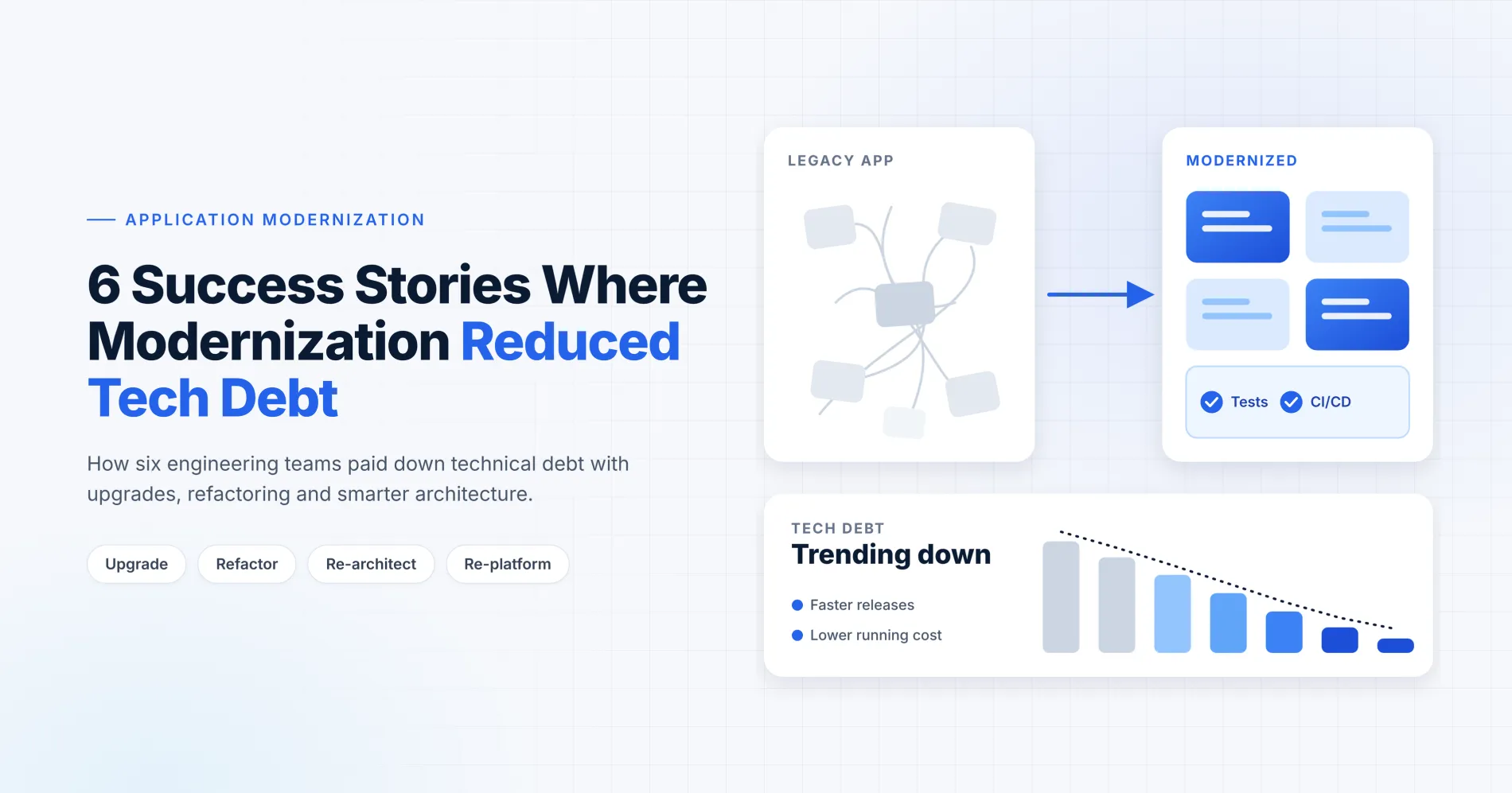
Your team wants to ship a new feature. Instead, they spend two weeks fighting an old framework, a fragile deployment and code nobody wants to touch. That is technical debt. And it gets more expensive every month you leave it.
Application modernization is how growing companies pay it down. It means upgrading, restructuring or re-platforming the software you already run, so it is cheaper to maintain and faster to change. This guide walks through 6 real success stories where modernization reduced tech debt. It also covers the patterns behind them and how to choose the right approach for your product.
At Skyphr, we work with founders whose products have outgrown their first codebase. We see the same debt patterns these big teams faced, just at a smaller scale. Every number below comes from the companies' own engineering blogs or leadership posts, not estimates.
What is application modernization?
Application modernization is the process of updating existing software so it fits today's business needs, tools, and scale. It rarely means a full rewrite. It usually takes one of four forms:
Upgrade: move to supported versions of your language, framework, and libraries.
Refactor: restructure code so each part has clear boundaries and an owner.
Re-architect: change how the system is split, from one big app into services, or from many services back into one.
Re-platform: move from your own servers to the cloud, or to a cloud setup that fits better.
Technical debt is the extra work you pay later for shortcuts taken earlier: outdated dependencies, tangled code, manual deployments and missing tests. Modernization targets that debt directly, so each release costs less effort than the last.
You will also hear it called legacy application modernization, legacy system modernization or software modernization. The goal is the same: software that helps your business move faster instead of holding it back.
Patching legacy code vs modernizing: what's the difference?
| Keep patching legacy code | Modernize the application | |
|---|---|---|
| Cost over time | Rises every year | Drops once the work is done |
| Release speed | Slows as code tangles | Smaller, faster, safer releases |
| Security | Unsupported versions, rising risk | Supported versions, current patches |
| Hiring and onboarding | Hard to staff old stacks | Modern stack, faster onboarding |
| Scaling | Hits hardware or design limits | Scales with demand |
6 application modernization success stories
1. Amazon: AI-assisted Java upgrades saved 4,500 developer-years
The debt: Tens of thousands of Amazon's production applications ran on Java 8 or 11. Upgrading each one by hand typically took about 50 developer-days. That is the kind of slow, boring work teams keep postponing.
What they changed: Amazon used the code transformation agent in Amazon Q Developer to automate the upgrades to Java 17. Developers reviewed and shipped the changes instead of writing them.
The result: The average upgrade dropped from about 50 developer-days to a few hours. More than half of Amazon's production Java systems were upgraded in under six months. Amazon estimates this saved 4,500 developer-years and delivers about $260 million a year in efficiency gains from better performance and security. Developers shipped 79% of the auto-generated code reviews without changes. (AWS)
The lesson: AI-assisted modernization makes the most tedious debt cheap to clear.
2. GitHub: upgrading a 10-year-old app from Rails 3.2 to 5.2
The debt: GitHub's main application was 10 years old and still ran on Rails 3.2, a version that no longer got official updates. The team was backporting security fixes to it themselves.
What they changed: Instead of a risky long-running branch, they made the app "dual boot" on two Rails versions at once. They upgraded one minor version at a time, with CI checks guarding each step, while feature work carried on.
The result: The project took a year and a half: one year from 3.2 to 4.2, then only five months from 4.2 to 5.2. Both upgrades went live with no downtime. The team also removed old custom code, moved the test suite closer to standard Rails, and started replacing a home-grown job runner with Rails' built-in Active Job. (GitHub Engineering)
The lesson: Upgrade early and often. Small, incremental steps beat one big, risky jump.
3. Shopify: turning a tangled monolith into a modular monolith
The debt: Shopify's Rails codebase had been built by over a thousand developers for more than a decade, with no boundaries between areas like checkout and shipping. By 2016, new features were getting harder to build and test. Tests ran slowly, and simple changes needed a lot of context.
What they changed: Shopify did not jump to microservices. In 2017 it started "Componentization": keep one codebase, but split it into components with strictly enforced boundaries, each owned by a team. (Shopify Engineering)
The result: The core monolith now holds over 2.8 million lines of Ruby, but developers can work on just the parts they own. Company-wide chores like Rails upgrades are shared across component owners. Shopify now runs its main monolith on the newest, unreleased revisions of Rails. (Shopify Engineering)
The lesson: You don't always need to split into services. Clear boundaries and ownership can cut debt on their own.
4. Netflix: rebuilding for the cloud instead of lifting and shifting
The debt: In August 2008, a major database corruption stopped Netflix from shipping DVDs for three days. The root cause was an architecture built on vertically scaled single points of failure.
What they changed: Netflix moved to AWS, but it did not simply copy old systems over. It rebuilt virtually all of its technology as cloud-native services. The migration finished in January 2016, after seven years.
The result: Netflix grew to eight times as many streaming members as in 2008, with viewing up by three orders of magnitude. Availability rose steadily toward its goal of four nines. Cloud cost per streaming start ended up a fraction of the data center cost. (Netflix)
The lesson: Lift-and-shift moves your debt to a new address. Re-architecting removes it.
5. Segment: consolidating 140+ microservices back into one service
The debt: Segment sent customer data to more than a hundred destinations, each with its own service, repo and queue. Over time this grew past 140 services. Shared libraries drifted to different versions, and operational overhead grew with every destination added. Developer productivity dropped.
What they changed: The team built a central system called Centrifuge to replace the per-destination queues. They then merged all destination code into one repo and one service. (SDxCentral)
The result: One engineer could now deploy, in minutes, a change that used to require deploying more than 140 services (IT Brief). Shared-library improvements rose to 46 in the following year, up from 32 in the microservices era (summary of Segment's write-up).
The lesson: Modernization means the right architecture for your team, not the trendiest one.
6. Prime Video: cutting a monitoring service's infrastructure cost by over 90%
The debt: Prime Video's tool for checking the quality of every video stream was built from distributed serverless components. Passing video frames between them through storage was costly and hard to scale.
What they changed: The team moved the components into a single process, so data no longer travelled over the network between steps. Prime Video as a whole still uses microservices. Only this one service was consolidated.
The result: Infrastructure cost for the service fell by over 90%, and its ability to scale increased. (DevClass)
The lesson: Review your architecture as usage grows. The design that got you started may not be the one that scales cheaply.
6 patterns behind every success story
They started from real pain, not a trend. A database outage, slow tests or rising costs drove each project.
They moved in small steps. GitHub upgraded one Rails version at a time, and Netflix migrated over seven years without stopping the business.
They picked the right architecture, not the fashionable one. Shopify kept its monolith, while Segment and Prime Video consolidated services.
They gave code clear owners. Boundaries and team ownership kept new debt from piling up again.
They automated the boring work. Amazon used AI for upgrades, and GitHub used CI to stop regressions.
They measured the outcome. Developer-days, deploy times and infrastructure cost proved each project paid off.
The hidden cost of technical debt
Try this simple calculation for your product:
Developers × % of time spent working around old code × monthly cost per developer = monthly cost of tech debt
Even a small team losing a fifth of its week to workarounds pays for a modernization project many times over. And that is before counting delayed launches, security risk and lost customers. Amazon's 50 developer-days per manual upgrade shows how fast those hours add up.
How to choose the right modernization approach
Before you start, ask these questions:
What hurts most today? Slow releases, outages, cloud bills and hiring problems each point to a different fix.
Is your stack still supported? End-of-life frameworks and libraries are the first debt to clear, as GitHub found.
Where are the natural boundaries? Map which parts of the app change together and who owns them.
Can you go step by step? Prefer incremental upgrades and gradual replacement over a big-bang rewrite.
Do you have tests? Good automated tests are what make modernization safe. Add them first if they are missing.
Does the target architecture fit your team? A five-person team rarely needs 50 microservices. Segment's story shows why.
Modernization is usually tied to bigger product goals, like new features or a new platform. If so, plan both together with a team that does custom software development and SaaS product development, so the new foundation supports what you build next.
How Skyphr modernizes applications
We don't push a one-size-fits-all rewrite. We modernize your application around how your business actually runs:
Audit: we review your code, dependencies, infrastructure and release process, and rank the debt by business impact.
Plan: we choose the right mix of upgrade, refactor, re-architect and re-platform, with clear milestones.
Modernize in slices: we change one module at a time, so your product keeps running and shipping.
Test and release: we add automated tests and CI/CD, so every change goes live safely.
Hand over and improve: we document the new setup, train your team and keep tracking results.
Through SkyAI, our AI engineering division, we also use AI-assisted tools for repetitive upgrade work, the same approach that saved Amazon thousands of developer-years. Your engineers spend their time on product work instead of version bumps.
Not sure where your debt sits? Book a call and we will walk you through a quick modernization review of your product.
Frequently asked questions
Ready to pay down your tech debt?
Every month you leave technical debt alone, it costs you more in slower releases and higher bills. Application modernization turns that cost into a faster, safer product.
Book a free 30-minute consultation with Skyphr, or explore SkyAI to see how we use AI in modernization projects. While you're here, get a free website audit with SkyLens to spot performance and SEO issues on your site.