How AI Is Revolutionizing Hospital Management Systems
Hospitals generate huge amounts of data every day, but most systems only store it. This piece covers six places where AI turns that data into better decisions: bed allocation, staff scheduling, early-warning alerts, clinical documentation, inventory, and EHR integration.
Varun Patel
Founder
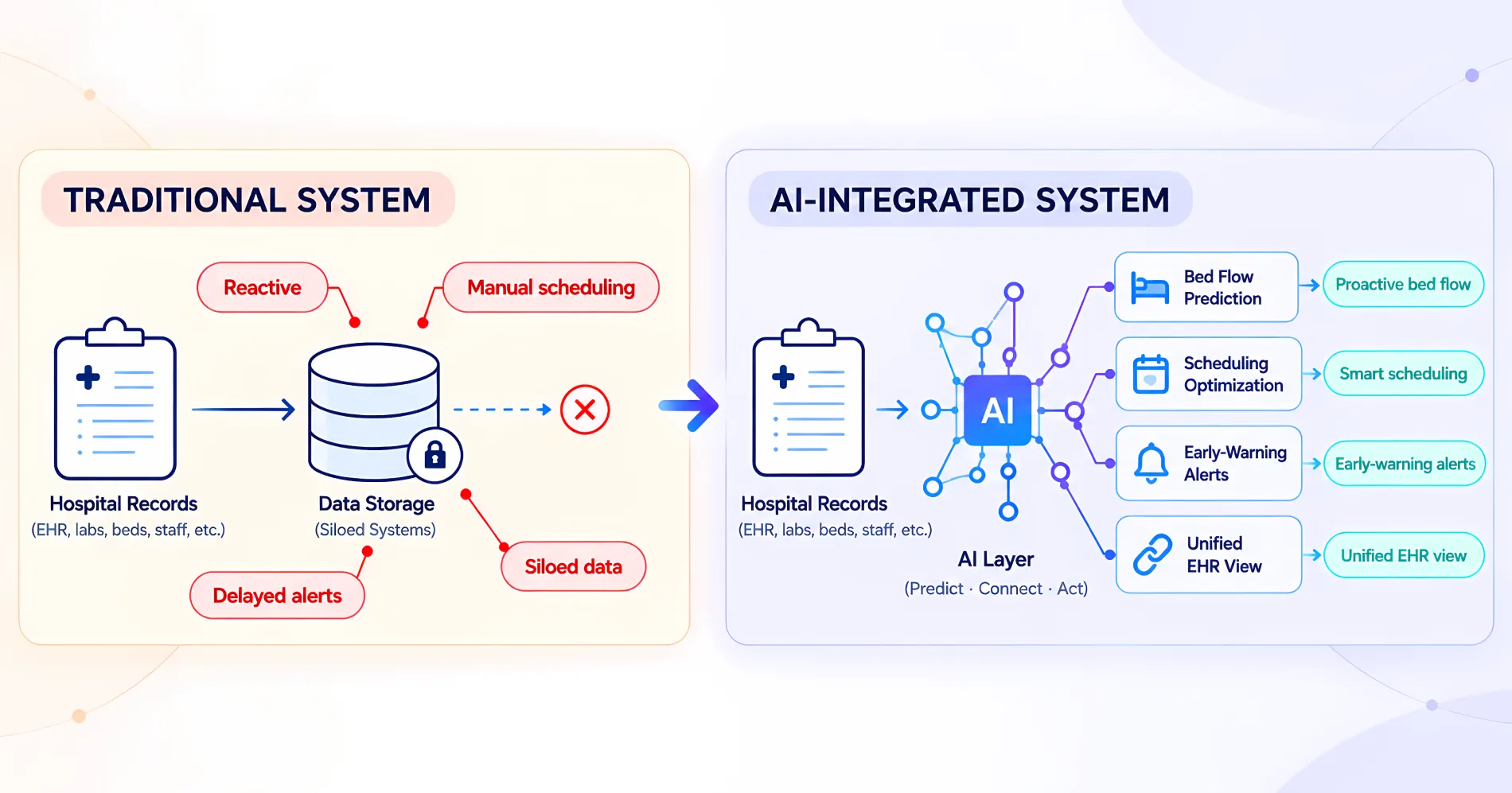
Healthcare generates enormous amounts of data every single day. From patient records, lab results, bed occupancy, staff schedules, equipment logs, and insurance claims.
Most of it never gets used the way it could.
Not because hospitals don't care. Because the systems managing that data were built for record-keeping, not decision-making. A hospital management system that just stores information is doing half the job. The other half is turning that information into faster decisions, fewer bottlenecks, and better patient outcomes. This is where AI is starting to change the equation.
Here's where that shift is actually happening, not in theory, but in the parts of hospital operations that decide whether a patient waits two hours or twenty minutes.
1. Patient Flow & Bed Allocation
The single biggest operational headache in any hospital is knowing which beds will be free, when, and for whom.
Traditional systems track bed status like occupied, vacant, cleaning. But AI-driven systems predict it ahead of time, using discharge patterns, admission trends, and even seasonal illness data to forecast bed availability hours or days in advance. That turns bed management from a reactive scramble into a planned process. Fewer patients stuck in hallways, fewer delayed admissions from the ER.
2. Smarter Scheduling For Patients and Staff
Appointment no-shows, overbooked specialists, understaffed night shifts. These aren't just inconvenient; they're expensive.
AI models can predict no-show likelihood based on patient history and automatically adjust overbooking to compensate. On the staffing side, the same predictive approach applies to nurse and physician scheduling, matching expected patient load to available staff instead of relying on static shift templates that don't flex with actual demand.
3. Predictive Admissions & Early-Warning Systems
This is where AI moves from "helpful" to genuinely life-saving.
Predictive models can flag early signs of patient deterioration. A subtle shift in vitals, lab trends, or medication response often before a human would catch the pattern manually across a busy ward. The same logic applies at the admissions level. Hospitals can forecast incoming patient volume based on regional health trends, weather events, or seasonal illness cycles, and staff accordingly before the surge hits, not during it.
4. Clinical Documentation Assistance
Physicians spend a significant share of their day on documentation instead of patients. AI-assisted documentation tools transcribing consultations, auto-populating structured fields from natural conversation, and flagging incomplete records reduce that burden without replacing clinical judgment. The doctor still decides. The system just stops making them type it all out twice.
5. Resource & Inventory Management
Medical equipment, medication stock, PPE. Hospitals run on inventory that can't afford to run out, but also can't afford to be over-purchased and wasted.
AI-based inventory systems track usage patterns in real time and predict reorder points before shortages happen, the same way modern retail systems forecast stock, except here, a stockout isn't a lost sale; it's a patient safety risk.
6. EHR Integration That Actually Works
This is the part that sounds simple and rarely is. "Just connect the EHR" is one of the most quietly complex asks in health tech. Different hospitals run different EHR platforms, each with its own quirks in how it exposes data, even when they claim to follow the same FHIR standard. An AI layer that sits on top of fragmented EHR data, normalizing it, making it queryable, surfacing insights instead of raw records - is often what separates a hospital system that feels modern from one that just feels digitized.
The Common Thread
Every one of these examples isn't "AI for the sake of AI." It's AI solving a specific operational bottleneck that was already costing hospitals time, money, or patient outcomes. The bed delays, no-shows, understaffing, stockouts, missed early symptoms, and physician burnout from paperwork.
That's the same principle behind every product we build at Skyphr . The AI has to know the workflow it's being dropped into, or it's just a feature nobody asked for.
How Skyphr Can Help You
This is exactly the kind of system we build at Skyphr . AI-integrated software that connects into existing operational data (EHR systems, scheduling platforms, inventory logs) rather than replacing what a hospital already runs, and turns that data into predictions and workflows staff actually use.
We don't start with the AI model. We start with the bottleneck - the bed that stays empty an extra six hours, the shift that's short-staffed every Thursday, the inventory order that always runs late. Then we build the system that fixes that specific problem, using the data the hospital already has.
If that sounds like a gap in your own operations, that's usually where this conversation starts.